Mobile Kitchen 101: Building a Vibration-Resistant Setup
Opening a food truck means designing a kitchen that survives potholes, sharp turns, and hundreds of miles a month without falling apart mid-shift. Mobile kitchen storage faces stresses that a stationary restaurant never encounters, and equipment sourced for a fixed location typically fails within its first year on the road.
Why Static Equipment Fails on the Road
Standard shelving built for a stationary kitchen lacks the reinforced weld points needed to survive constant transit vibration. Within a few hundred miles, bolted joints begin to loosen as vibration works screws free from their threads, whereas welded seams hold their geometry indefinitely. For wall-mounted units, 16-gauge brackets paired with 1.5 inch support mounts distribute the load across a wider surface area, reducing the stress concentrated at any single anchor point. This is exactly why mobile kitchen storage specs differ so much from the standard NSF shelving used in fixed kitchens. Operators who skip this spec often notice sagging shelves within 500 miles of driving, well before the truck reaches its first oil change. A shelf that shifts even a quarter inch under load can also become a safety issue during hard braking, since loose cans and containers turn into projectiles inside the cabin.
Sanitation and Airflow in Confined Spaces
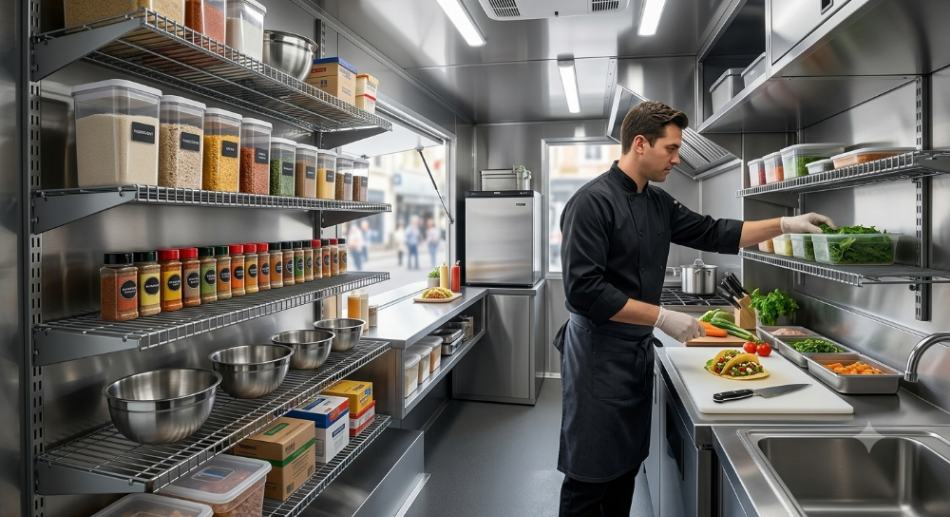
A second problem specific to trucks is moisture trapping – condensation forms in the gap between a flush-mounted shelf and the wall, and without airflow that moisture sits long enough to support mold growth. Epoxy-coated wire shelving addresses this directly, since the open wire construction lets air circulate behind stored items rather than sealing off a stagnant pocket. Finding good shelving in a food truck is critical; many operators look to specialists for NSF-certified wire racks that prevent dust buildup. NSF wall shelves rated for the load of dry goods versus glassware need separate placement, since a shelf sized for canned goods will flex under the concentrated weight of stacked plateware.
Vibration-resistant racks built from open wire, rather than solid sheet steel, also shed grease and debris more easily during a wipe-down between services.
Getting Good Shelving in a Food Truck right from day one avoids costly retrofits after the first month of service. Investing early in vibration-resistant racks and epoxy-coated wire shelving keeps a mobile kitchen passing inspection and running efficiently for years. Operators building out a new truck should request weld specifications from any equipment supplier up front, rather than assuming standard kitchen shelving will hold up once the vehicle is on the road full time.
FAQ
Q: How do I secure shelves to food truck walls?
A: Use welded brackets rather than adhesive or single-screw mounts, and back the mounting points into the truck’s structural wall studs rather than the interior panel alone, since panel-only mounts loosen under sustained vibration.
Q: Is chrome or epoxy better for mobile kitchens?
A: Epoxy-coated wire generally holds up better in a moving vehicle, since it resists chipping from vibration-related contact and sheds moisture faster than chrome plating, which can show corrosion at scratch points over time.